Change doesn’t have to break us apart, it can be what binds us.
It began in a meeting room I wasn’t invited in.
I was navigating one of the largest merger-and-acquisition processes in the eyewear industry, as a Public Relations Executive during my time living in the United States.
A change was in the air but not yet spoken aloud, just vague instructions to build a three-year plan for sales, marketing, and product.
A one-day team retreat was scheduled, meant to be strategic, but I soon realised no one had considered the PR and communications team’s involvement essential.
Exclusion tingled through me.
Interpreting intentions over muffled conversations in glass rooms. Refreshing inboxes and calendars for clues. Asking urgent questions and bearing the silence that came with them.
If I wasn’t in the room, I couldn’t understand what was unfolding or help shape it. And as a team leader, the people who would live with the consequences were sitting in meetings with me every day, carrying on business as usual.
Standing on the sidelines felt unsafe.
So I invited myself in.
In that room, I went team leader by team leader, making my case: If I could sit in as a kind of “journalist in the room” I could help uncover blind spots, connect perspectives, and make the collaboration better just by asking questions.
They eventually said yes, half curious, half doubtful.
Inside that yes, something opened.

The room before the shift
The retreat followed a familiar script for periods of tension: long decks, siloed presentations, defensive posturing, leaders claiming territory instead of connection.
Which meant that people disengaged quietly; eyes glazed; bodies leaned back, unsure of their active role. The room felt like a set of parallel monologues from various leaders.
From this context, I began asking questions, both for myself and for the room:
– “How does this connect with what [another department] shared earlier?”
– “What do we actually mean by ‘growth’ here?”
– “Who is missing from this picture?”
– “What problem are we trying to solve, in one sentence?”
The more questions I asked them, the more they asked me to stay.
People started pulling their chairs close to the stage, raising their hand offering their point of view, and even laughing together. The room became less like a performance and more like a shared quest.
By the end of the day, we had three common directions we were happy with. Within a week, headquarters received all teams’ submissions on the plans.
“We’ve never had a common plan in such a short turnaround. Thank you, everyone.”
The Marketing Director wrote back, half stunned.
A revelation in the in-between
It is only now, as a belonging designer, that I understand what was happening back then.
We were suspended in what I now call the in-between: the cultural space that opens after letting go of what was, but before knowing what will be.
In that space, familiar frameworks loosen. No formal orientation is yet offered. The people who usually hold the answers feel further away. Leadership becomes fluid, sometimes contested. Teams start solving for survival, even when the stated goal is alignment.
And beneath it all, a quiet, very personal question moves through the organisation:
Do I still belong here?
But during transitions, the feeling of ‘not belonging’ is not, in fact, the opposite of belonging.
Rather, it is often the first signal that belonging is asking to be redesigned – a possibility for innovation and more sustainability in the long term if we choose to act accordingly.
It was in that loosening that I stepped in. Not because I was heroic. But because the cost of resentment felt higher than the cost of responsibility.
That moment revealed something I now use with every client journey.
Belonging design in the in-between is the practice of tending to the relational space that opens up during transitions when people are asked to let go of what was before they know what comes next.
In these moments, culture moves faster than strategy.
What makes these moments challenging is that teams usually react by drafting strategy, plans, budgets, steering committees – all necessary. Meanwhile, culture is already rearranging itself informally: through conversations, silences, alliances. New relational patterns form. Informal authority emerges. Trust thins or deepens.
If that layer is ignored, fragmentation grows quietly and spreads rapidly.
But when community is intentionally designed above and beyond the everyday inertia of team work – when leaders and teams co-create shared language, shared visibility, and shared responsibility inside uncertainty – something shifts.
People begin orienting together instead of bracing alone.
Belonging design is not about making people comfortable with change. It is about designing the conditions that allow them to stay present, connected, and agentic inside uncertainty.
When I stepped into that informal role during the retreat, I saw people come alive.
Not because the content changed. But because the conditions did. By shifting the posture in the room – taking on the role of the bridge rather than another stakeholder – we designed, even temporarily, a community inside transition, moving from defending territory to building something shared.
I learned something simple and enduring
People don’t resist change. They resist changing alone.
And they rarely commit to a future they did not participate in shaping.
Organisations in transition are full of people standing in the hallway between who they were and who they are becoming. Most have never been taught how to stand there.
When leaders and teams step into organisational transitions – from mergers to leadership changes, market crises or even a move to a new office – belonging isn’t inherited from the past, but built by orienting together inside uncertainty.
Standing well in the in-between is not soft work. It is learning to lead change so that transformation carries people with it instead of leaving them behind.
From teams to communities of courage
In moments of transition, the gap between being assigned to a team and choosing to belong becomes visible. The words we use to describe community shape the posture we default to when pressure rises.
When I ask my clients (including top-reputied global companies like the LEGO Group, Edison, Roche, Michelin) to define “community” at work, a shared definition emerges every time: a community is shaped by choice.
Different leaders told me:
“A team is task-oriented. A community is empathy, support, and choosing to engage on a deeper level.”
“You live your work, not just do it.”
“A community desires to create a supportive environment, mutual understanding and shared responsibility and it goes beyond simply getting the job done”
A community is not a team by default (more on this to come in another post) because where a team performs tasks, a community shares meaning.
Inside organisations shaped by urgency, overload, and hyper-uncertainty, choosing belonging can feel like a nice to have.
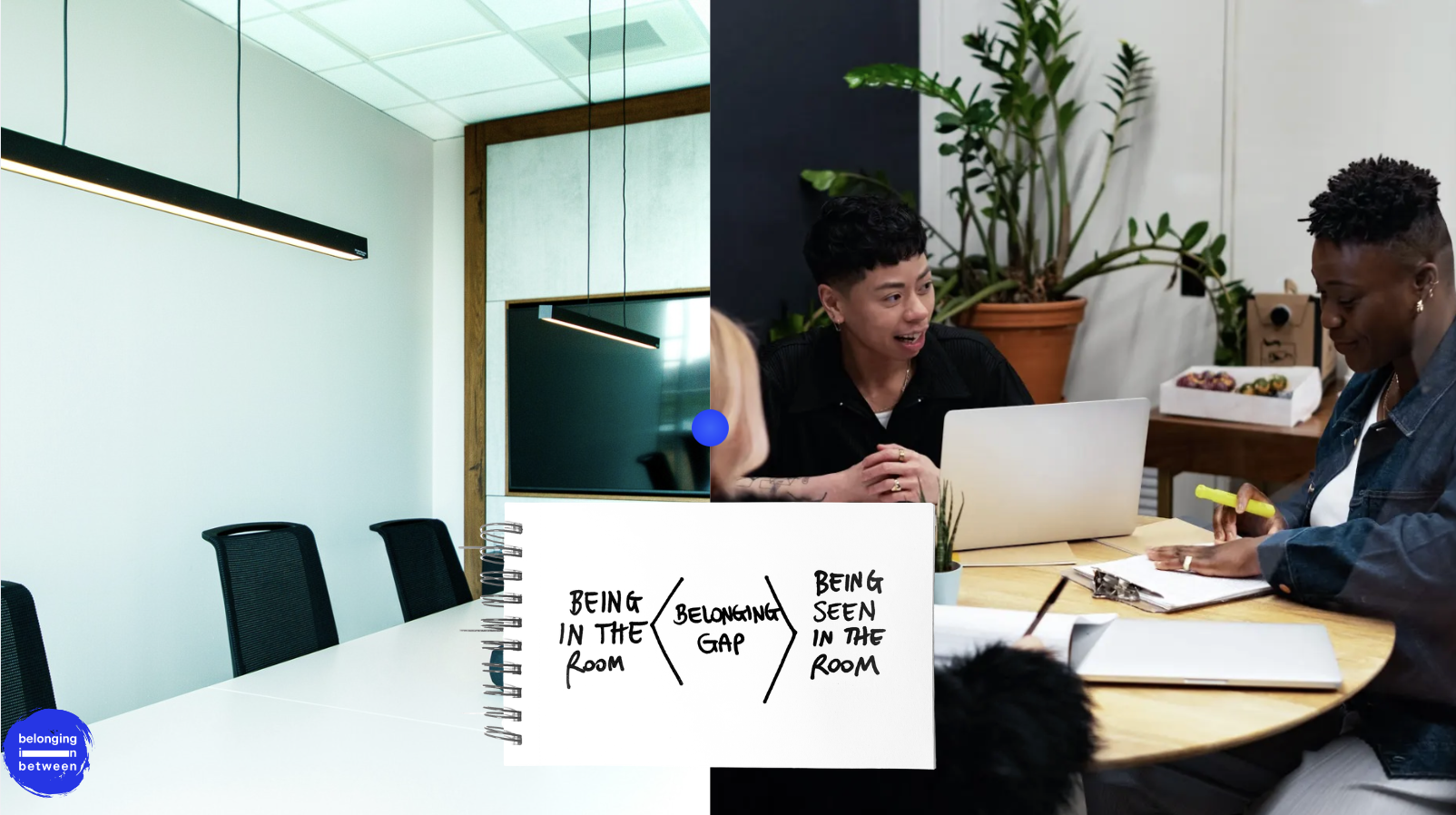
Leaders often dismiss it as “not essential right now,” revealing a deeper truth, what I call the belonging gap: the distance between being in the room and being seen in the room.
Between showing up and being recognised, valued, and connected to purpose while we do it.
The belonging gap isn’t abstract, it’s operational.
The energy, focus, and care an organization invests in that space determines its ability to navigate change.
- When the gap is felt but unnamed, it becomes a threshold: people hesitate, protect themselves, and wait for signals that never come.
- When the gap is named but ignored, it becomes a fault line: teams default to compliance, silos, and defensiveness.
- When the gap is intentionally designed for, it becomes a bridge: people shift from task execution to shared ownership.
This is the inflection point between a team and a community: one only survives change, the other transforms through it.
So how can we move from a group of individuals performing a task out of necessity into a community at work?
A lesson from spaghetti and marshmallows
In the renowned team-building exercise and design activity created by Peter Skillman and popularized by Tom Wujec, groups were given a limited amount of time and materials (typically 20 sticks of dry spaghetti, one yard of tape, one yard of string, and one marshmallow) to build the tallest possible free-standing structure with the marshmallow placed on top.
A key finding was that a group of CEOs consistently lost to kindergartners in the design challenge. The children iterate playfully and learn fast; the CEOs try to get it “right” in one go and collapse at the end.
Interestingly, when they added just one administrative assistant in the experiment, someone who naturally connected the team – then the CEOs suddenly outperform the kids.
This shows us that during transitions, a belonging-first approach plays the exact same role as that assistant: it creates the conditions for fast, relational learning instead of slow, perfectionist collapse.
Belonging is the enlivening force that makes learning fast instead of fearful.
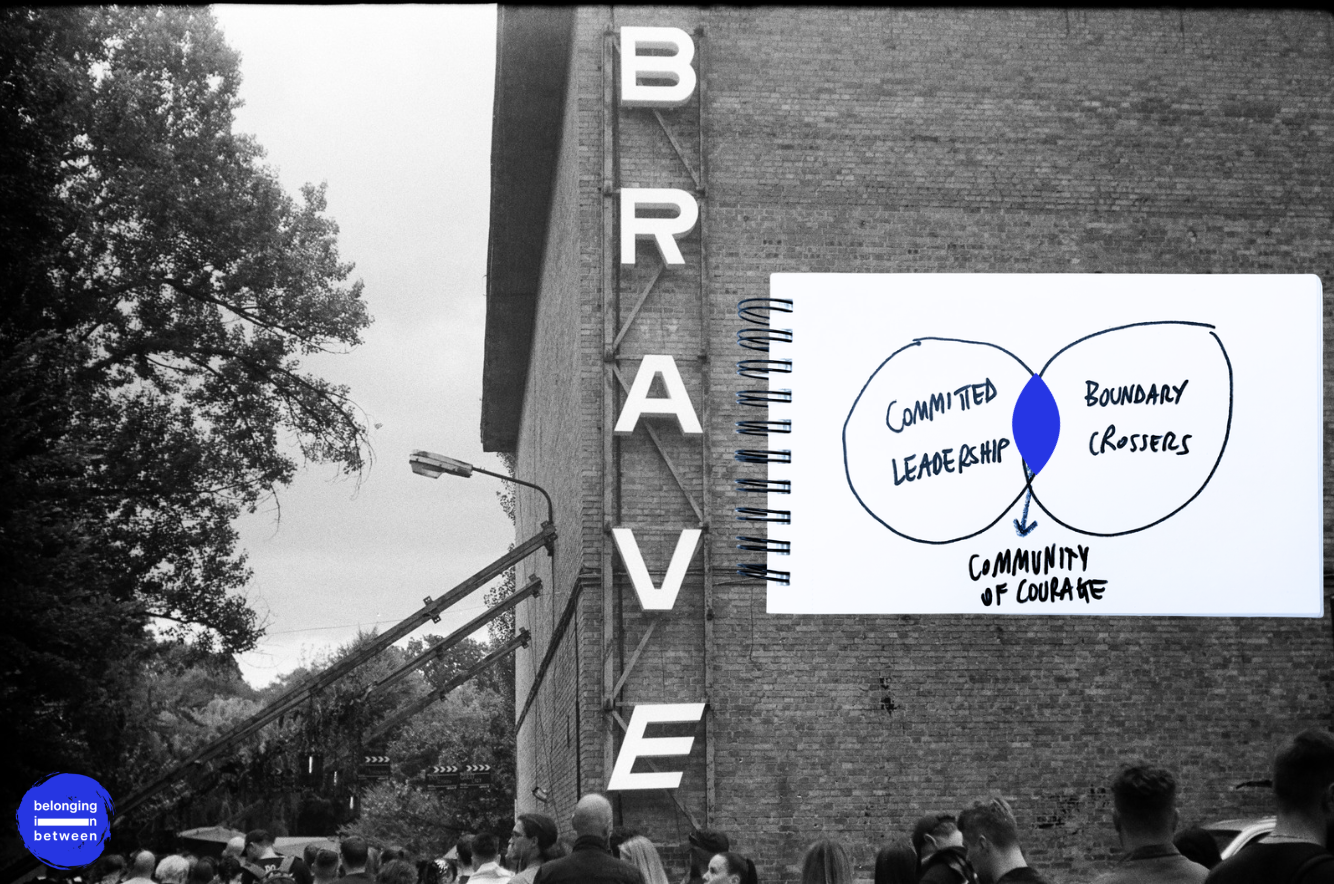
Through my research on belonging, I’ve learned that organisations evolve when two forces meet:
- Committed leadership designing conditions – psychological safety, shared language, clear roles, trust. The amount of effort, focus and time leaders spend designing the conditions for successfully inhabiting the belonging gap, directly influences the way people contribute (or not) to the change in place.
- Boundary-crossers – people who dismantle silos by forming communities of practice that keep learning alive.
People stop functioning as isolated units and begin to operate as more than the sum of their roles. The relational “middle ground”, the space between strategy and execution that usually stays hidden, becomes visible and usable.
That is the space where innovation lives. And it’s also the space where most organizations unintentionally lose their people.
Recent research from Harvard Business Review (2025) shows that middle managers feel the least psychologically safe of anyone in the organisation – even less than their own teams.
“Middle managers are the linchpin between strategy and execution, the organization’s central nervous system. When they don’t feel safe to voice concerns or admit mistakes, the feedback loop breaks. Vital information never reaches the top, problems remain undiagnosed, and the whole system risks falling behind.”
– Harvard Business Review, 2025
This is why communities at work matter: not only as culture initiatives, but as relational infrastructures that allow people to co-create across silos, share risks, metabolise uncertainty, and repair what breaks in real time.
When organisations design these safe-to-risk spaces, middle managers stop buffering between layers and start co-creating with leaders and other team members. Accountability becomes shared, not delegated. Learning becomes relational, not procedural.
When the belonging gap is intentionally designed for, it becomes a bridge: people shift from task execution to shared ownership
This is what I call a community of courage: a group that willingly stays in the discomfort of change together because they feel seen, held, and able to act. It is the edge you need in moments of change: it redesigns the accountability system to encourage constructive risk-taking.
As you grow as an organisation, every brilliant solution today has the potential of becoming a problem tomorrow. But if you think and design as a community and not as a team with a belonging-first approach it guarantees that no matter the problem, people will not waste time in fixing it.
When an entire business unit stood in the in-between
During a recent project as a belonging designer, a General Manager of a global brand invited me into a moment of overlapping transitions: a move to a new office, leadership turnover, market contraction, declining reputation, and a regional shift in power.
The leadership team needed results; while the wider business unit didn’t recognise itself in the emerging direction.
The leaders said: “We need to align around one number.”
The teams said: “We don’t see ourselves in the story anymore.”
While expecting they would feel agile enough during this pivot, all teams felt stuck and disengaged and they were reactively living through the urgency of frustration.
They had tried every intervention, the entire “medical cabinet,”of training, toolkits, methodologies. Nothing truly stuck.
The reason?
Belonging had nowhere to land.
Everyone was too busy focusing on the four tensions I’ve come to coin in my work as the urgent pressures that surface in every transition including:
- Results – the tension between the results leaders must deliver and the reality people are living through.
- Retention – the tension between individual purpose and the organization’s stated values.
- Reputation – the tension between who we believe we are and who we are perceived to be.
- Renewal – the tension between continuous change and the organization’s capacity to metabolise it.
The reason this global brand felt so stuck? They had quietly lost the fifth and most essential R: the R of Relationships, a.k.a the relational field that makes the other four Rs possible.
Because without Relational Leadership, Results become pressure, Retention becomes exhaustion, Reputation becomes performance, and Renewal never takes root.
This is where belonging in between entered. In a siloed organisation under pressure, we did not introduce another toolkit. We redesigned the room.
We formed a cross-functional community of courage — leaders and team members meeting outside their reporting lines with one mandate: surface the tensions shaping the strategy before finalizing the strategy itself.
What shifted in the room directly affected decisions.
Targets were recalibrated. The regional narrative was rewritten. The office move became a symbolic reset rather than a logistical exercise. The work changed how decisions were made.
It influenced strategy while it was still malleable. And it showed up in performance and data.
The fifth R — Relationships — was restored as infrastructure.
And once that happened, the four tensions stopped erupting as resistance and started functioning as intelligence.
People described the shift as moving from being “employees hired to do a job” to “volunteers choosing to build something that matters.”
It was the difference between compliance and aliveness.
Between executing a plan and co-owning a direction.
"It didn't feel like a traditional team, more like a collective purpose. It was contagious"
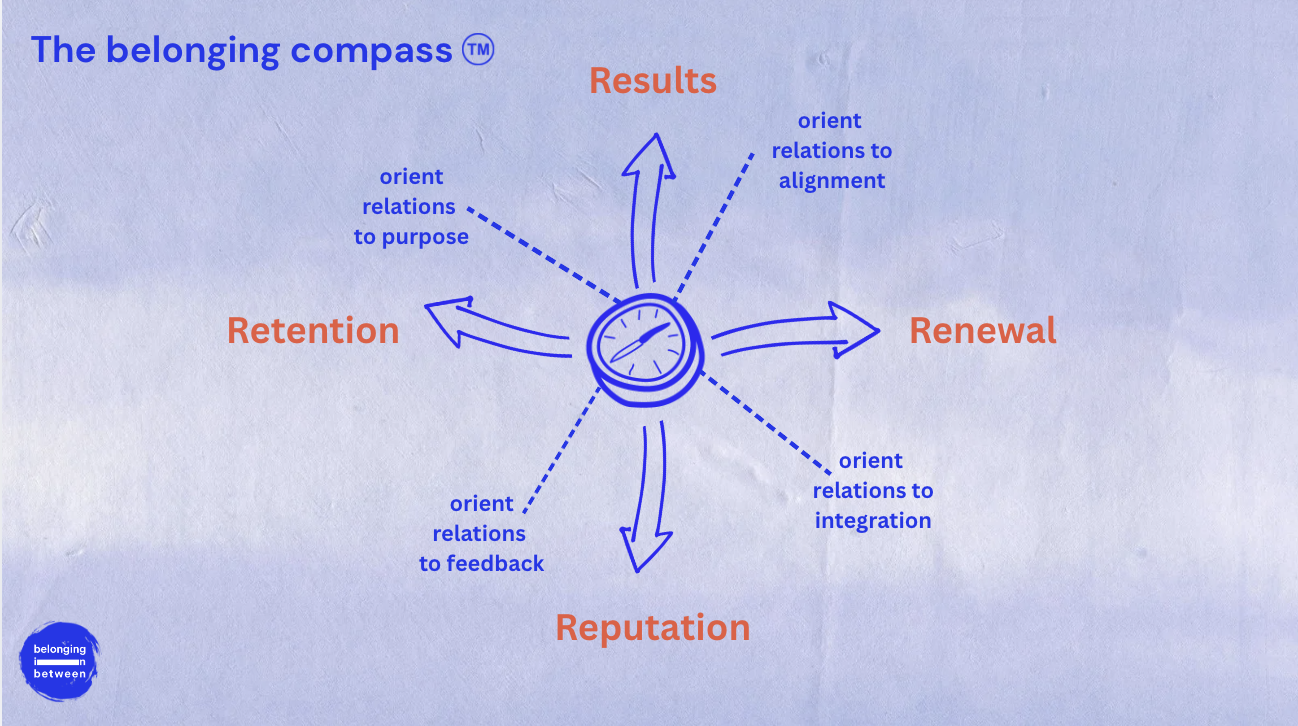
The Belonging Compass ™ help us orient together during change
I designed the Belonging Compass ™ to help leaders and teams orient together during change, after many years years of navigating transitions from both inside executive teams and alongside them as a strategic advisor, designer and facilitator.
In my work with leaders and teams we use it as shared diagnostic and sense making practice.
When teams move through uncertain terrain, clarity does not come from a perfect map. It comes from increasing collective awareness of what is already happening in the system.
The Compass invites leaders to locate where tension is most alive across four relational coordinates – north (Results), south (Reputation), east (Retention) and west (Renewal).
Each point helps you spot early signals in language, behaviour, and decision-making patterns before fragmentation hardens.
From that shared visibility, small, deliberate shifts become possible.
The Belonging Compass ™ is designed to hold direction without rigidity and supports movement without leaving people behind.
Standing well in the in-between means leading change that does not leave people behind
The Results Tension (North)
Between the results leaders must deliver and the reality people are living through.
When change is pushed before culture is ready, misalignment turns into defensiveness. Trust erodes, experimentation shuts down, and comparison replaces connection. The system fractures exactly when unity is most needed.
You know this tension is at work when you hear:
“We just need to execute.”
“There’s no time for this conversation.”
“We’ll fix culture after we hit the numbers.”
You see:
Meetings dominated by metrics but thin on shared understanding.
Experimentation shrinking.
Increased comparison across teams.
A subtle rise in defensiveness.
North of the Compass invites leaders and teams to pause long enough to restore shared orientation before pushing alignment.
When results become the only language, pressure replaces trust.
When results become shared direction, coordination strengthens.
The Retention Tension (West)
Between individual purpose and the organization’s stated values.
When early invitations lack coherence, people struggle to locate themselves in the story they’re joining. Values stay declarative while daily work reflects something else. Learning grows in silos, connection thins, and belonging erodes long before people leave.
You know this tension is at work when you hear:
“This isn’t what I signed up for.”
“That’s not how we actually operate.”
“Values are just posters.”
You see:
Early disengagement from new hires.
High performers going quiet before they leave.
Learning happening in silos.
Energy dropping in moments that should feel meaningful.
West of the Compass helps leaders and teams notice when belonging is thinning long before attrition shows up in data.
When purpose remains abstract, retention becomes transactional.
When belonging is intentionally designed into everyday work, continuity strengthens.
The Reputation Tension (South)
Between who the organization believes it is and who it is perceived to be.
When truth has no safe path upward, silence becomes the operating system.
Feedback collapses, comparison replaces connection, and coherence turns performative. Reputation becomes surface, not substance.
You know this tension is at work when you hear:
“That’s not how leadership sees it.”
“Better not raise that.”
“We can’t say that out loud.”
You see:
Silence where candor is needed.
Feedback traveling sideways instead of upward.
Over-polished messaging paired with internal skepticism.
Leaders performing certainty.
South of the Compass draws attention to the movement of truth inside the system.
When truth has no safe path upward, reputation becomes surface.
When candor becomes shared practice, credibility rebuilds from within.
The Renewal Tension (East)
Between continuous change and the organization’s capacity to metabolize it.
When change moves faster than meaning, endings are rushed and new behaviors don’t take root. Experiences go unintegrated, creating parallel realities, silent subcultures and quiet fatigue. Cultures fray not because change is happening, but because renewal is confused with pressure.
You know this tension is at work when you hear:
“We have always done it that way!”
“Didn’t we just try this?”
“Can we just stabilise for a minute?”
You see:
Initiatives stacking without integration.
Quiet fatigue.
Parallel realities forming across teams.
New behaviours announced but not embodied.
East of the Compass helps leaders and teams detect when renewal is being confused with acceleration.
When change outruns meaning, culture frays.
When integration becomes rhythmic, renewal strengthens direction and coherence.
The Belonging Compass ™ does not offer quick fixes.
It helps leaders and teams see what is already unfolding in the relational field and co-design agency when tensions escalate into resistance, attrition, or reputational fracture.
From there, change becomes less about pushing harder as a team and more about orienting together as a community.
An invitation to begin the work
If your organisation is standing in its own in-between – pulled between results, retention, reputation, and renewal – you’re not failing.
You’re navigating a threshold asking for belonging. A signal to invest in relational leadership as your primary laboratory for innovation.
This is the work of belonging in between creating the conditions for people to speak, stay, and shape what comes next together.
If it feels time to pick up the compass and orient, I offer a first conversation to help you do just that.
A 30-minute space to pause, listen, and make sense of what this moment is asking of your organisation – without pressure to decide what comes next. You will receive a report of our conversation.
You might begin by asking:
- What conversations feel too risky to host?
- Where has belonging had nowhere to land?
- Which tension is loudest right now?